Last reviewed by Manish Kumar: October 26, 2026. Facts were checked against the primary sources listed at the end of this article.
“Do we actually need life insurance now that we have a mortgage?” In my conversations with London families who have just picked up their keys, this is usually the second question, right after “what did I just sign at the bank?” It’s a fair question. The honest answer is that it depends on who would be left with the payments, and the amount you need is often different from the number on your mortgage statement.
The short answer
- No one can require it. In Canada, you don’t need to buy life insurance to be approved for a mortgage. The Financial Consumer Agency of Canada (FCAC) says optional mortgage insurance is your choice, the lender can’t insist that you buy it, and you must give your express consent.
- You may need it if someone relies on your income to keep the home. That usually means a partner, children or a co-owner. If no one depends on you, FCAC points out that the home can be sold to pay back the mortgage, so you may not need mortgage coverage at all.
- How much: start with the mortgage, but don’t stop there. A practical estimate is the mortgage you’d want covered, plus the other costs your family would face, minus savings and coverage you already have.
- Which kind: you have choices. Lender mortgage life insurance pays the lender, and the benefit generally shrinks as you pay down the loan. A personal term or permanent policy pays the people you name. FCAC says term or permanent life insurance may provide better value because its death benefit doesn’t decrease.
- Don’t mix it up with CMHC insurance. Mortgage loan (default) insurance can be required when your down payment is under 20%, but it protects the lender, not your family.
Is life insurance required to get a mortgage in Canada?
No. Life insurance is not a requirement for getting a mortgage in Canada. FCAC explains that optional mortgage insurance is a type of credit and loan insurance that you’re usually offered when you take out or renew a mortgage, and that you don’t need to purchase it to be approved (FCAC, Optional mortgage insurance products).
FCAC also says your lender can’t force you to buy a product as a condition of getting another one, which is called coercive tied selling. If your lender is a federally regulated bank, it must offer products that are appropriate for your circumstances and tell you if it has assessed that a product isn’t appropriate for you. You can also buy coverage from another insurance company instead of the lender.
Is CMHC insurance the same thing?
No. CMHC insurance is mortgage loan insurance, and it’s the one type of “mortgage insurance” that can be required. CMHC explains that if you buy a home with a down payment of less than 20%, you’ll need mortgage loan insurance, which protects your lender in case you can’t make your payments (CMHC). It lets you get a mortgage for up to 95% of the purchase price.
It does nothing for your family if you die. That’s a separate decision, and it’s the one this article is about.
Who usually needs life insurance for a mortgage?
You’re most likely to need it if your household couldn’t keep up the mortgage payments, or wouldn’t want to sell the home, without your income. Mortgages are common: in Statistics Canada’s 2023 Survey of Financial Security, nearly 4 in 10 Canadian families (39%) held a mortgage, and the median mortgage debt among those families was $205,000 (Statistics Canada, 2024, in 2023 dollars).
The patterns I see most often in my work around London, Ontario:
- Two incomes, one mortgage. The payment was approved on both paycheques. If one stops, the other often can’t carry it alone, plus childcare.
- One main earner. A partner at home with young children is often the person who would need the most help, both with the home and with income.
- Single parents. There’s no second income, and the kids’ stability is usually the priority.
- Co-owners who aren’t a couple. Siblings, friends or a parent and adult child who bought together may each want the other protected.
- Self-employed owners. There’s often no group life insurance at work to fall back on.
You may need little or no new coverage if you’re single with no dependants, if your savings could clear the mortgage, or if your existing coverage already fits the need. FCAC suggests checking employer coverage and other policies before buying mortgage life insurance.
How much life insurance do you need for a mortgage?
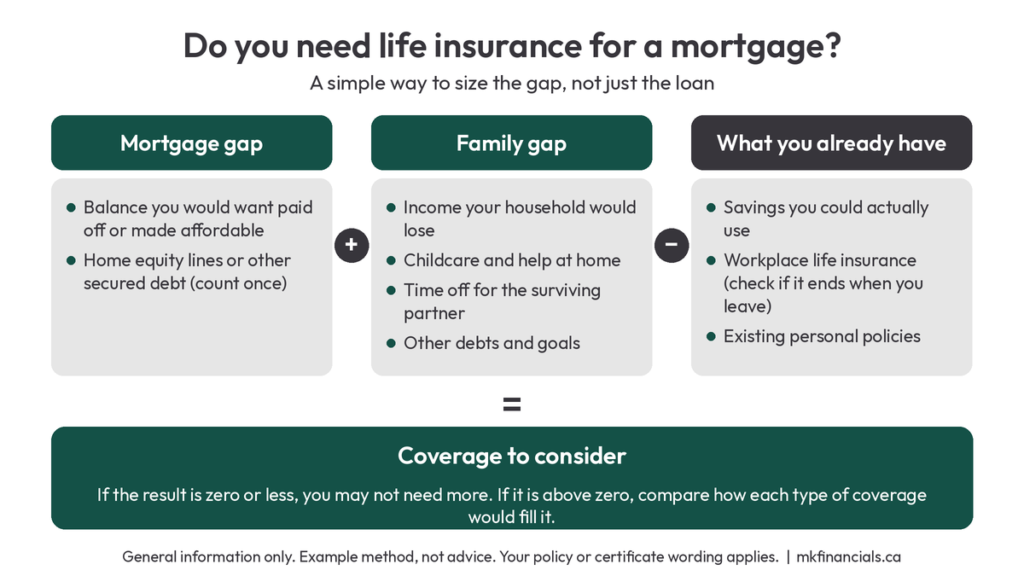
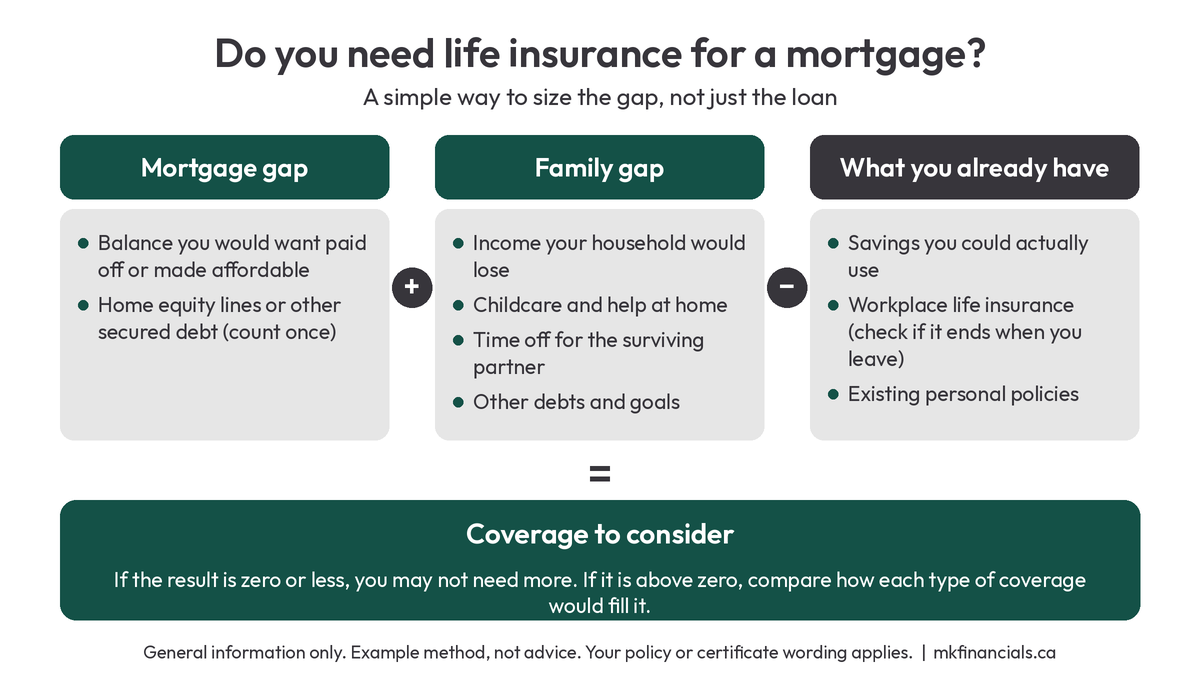
A useful starting point is the mortgage balance you’d want paid off, plus the other costs your family would face, minus the money and coverage that would really be available. The result can be more than your mortgage, less than it, or zero.
- The mortgage gap. The balance you’d want cleared or made affordable. Include a home equity line of credit or other secured debt once, not twice.
- The family gap. Income your household would lose, childcare or help at home, time off for the surviving partner, funeral and transition costs, other debts, and goals such as education.
- What you already have. Savings and investments your family could actually use, workplace life insurance (check whether it ends if you change jobs) and existing personal policies.
Our life insurance needs calculator can help you organize the numbers. Treat the result as a planning estimate, not a recommendation. FSRA describes this kind of financial needs analysis as the first step an agent should take with you (FSRA).
Example only: two ways to size the same household
Example only. This is a made-up household to show the method. It isn’t a quote, a recommendation or a real client, and it doesn’t include any premiums.
Priya and Daniel live in London, Ontario, with two children aged 3 and 6. They owe $480,000 on their mortgage. Daniel has $100,000 of group life insurance at work, and they have $30,000 in savings they’d be comfortable using.
Method 1: match the mortgage. Coverage on Daniel of $480,000 would clear the loan, but nothing would be left for childcare or the income Priya would lose while she adjusts.
Method 2: size the whole gap. They estimate $480,000 for the mortgage, plus $150,000 to top up household income for a few years, $60,000 for childcare and help at home, $25,000 for a car loan and $20,000 for final and transition costs. That’s $735,000. Subtract the $100,000 group coverage and $30,000 of savings, and the gap is about $605,000.
If Daniel changed jobs and lost his group coverage, the gap would grow to about $705,000. That’s why some families don’t count workplace coverage in full. All numbers are made up and rounded to show the method.
Want a second set of eyes on your numbers? Bring your mortgage statement and any workplace benefits booklet. I’ll help you work out the gap and compare options in plain language, with no pressure to buy.
Which kind of life insurance fits a mortgage?
There are three common ways to cover a mortgage, and the biggest differences are who gets the money and whether the benefit stays the same. Here’s how they generally compare:
| Lender mortgage life insurance | Personal term or permanent life insurance | Workplace group life insurance | |
|---|---|---|---|
| Who receives the money | The lender, to pay down the mortgage | The beneficiary you name, for any purpose | The beneficiary on your plan record |
| Benefit over time | Equal to the balance, so it decreases as you pay down the mortgage | The amount you choose. It stays the same while the policy is in effect | Set by the plan, often tied to salary |
| Premiums | Based on your age and mortgage amount when you apply, and generally stay the same | Based on age, gender, medical history and amount. Fixed or increasing, depending on the policy | Often paid fully or partly through work |
| If you refinance, switch lenders or change jobs | Tied to that mortgage, so check the certificate | Separate from the lender and your job | Often ends or changes when employment ends |
| Often fits | Simple, mortgage-only protection | A family that wants control over the amount and how it’s used | A base layer, not usually a full plan |
The first three rows for lender and personal coverage follow FCAC’s comparison (FCAC). Your certificate or policy is the contract that decides the actual result. For a detailed side-by-side, read mortgage insurance vs life insurance: a real comparison.
For many young families, personal term life insurance is the first option they look at, because it covers a set period at a lower starting cost than permanent coverage. FCAC notes that term premiums are generally less expensive than permanent premiums when you first buy, but the coverage ends when the term ends and there’s no cash value (FCAC, Life insurance). You can see the options we help with on our mortgage protection insurance page.
How long should the coverage last?
Coverage should generally last as long as your longest need, which may be the mortgage amortization or the years until your children are independent, whichever is later. Your mortgage term (often five years) is not the same as your amortization (often 25 years or more), so check which date you’re planning around.
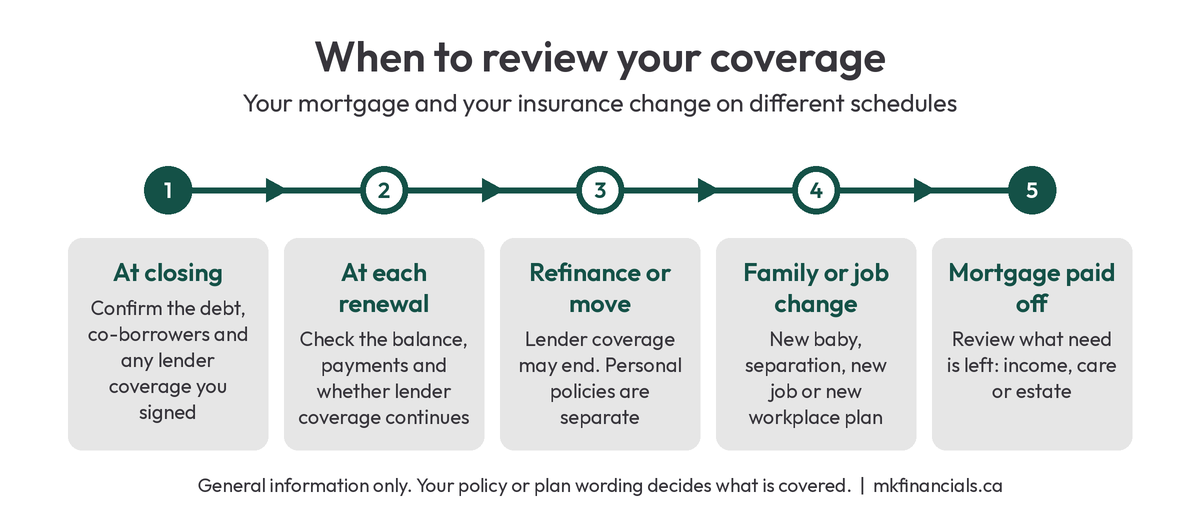
Our term length calculator can help you line up the dates. It also helps to plan reviews at the moments when your mortgage or family changes:
Questions to ask your lender before you sign
If you’re offered mortgage life insurance, ask for the certificate of insurance and read it before you decide. FCAC suggests using the certificate to check (FCAC, Credit or loan insurance):
- whether you’re eligible for coverage, and what it will cost
- the maximum benefit, and when benefits would be paid
- what counts as an exclusion or limitation, and any limits on claims
- whether there’s a maximum age. FCAC says it’s often between 65 and 70
Two details often surprise people. First, FCAC explains that you usually answer a short yes-or-no health questionnaire, and that your insurance won’t be valid if your answers aren’t accurate. Second, at claim time the insurer may ask for more information or a medical exam, and may not pay if you had a related pre-existing condition. Ask in writing whether your coverage is fully approved. FCAC also says you can cancel credit or loan insurance at any time, but don’t cancel any coverage until a replacement is approved and in force.
Your decision checklist
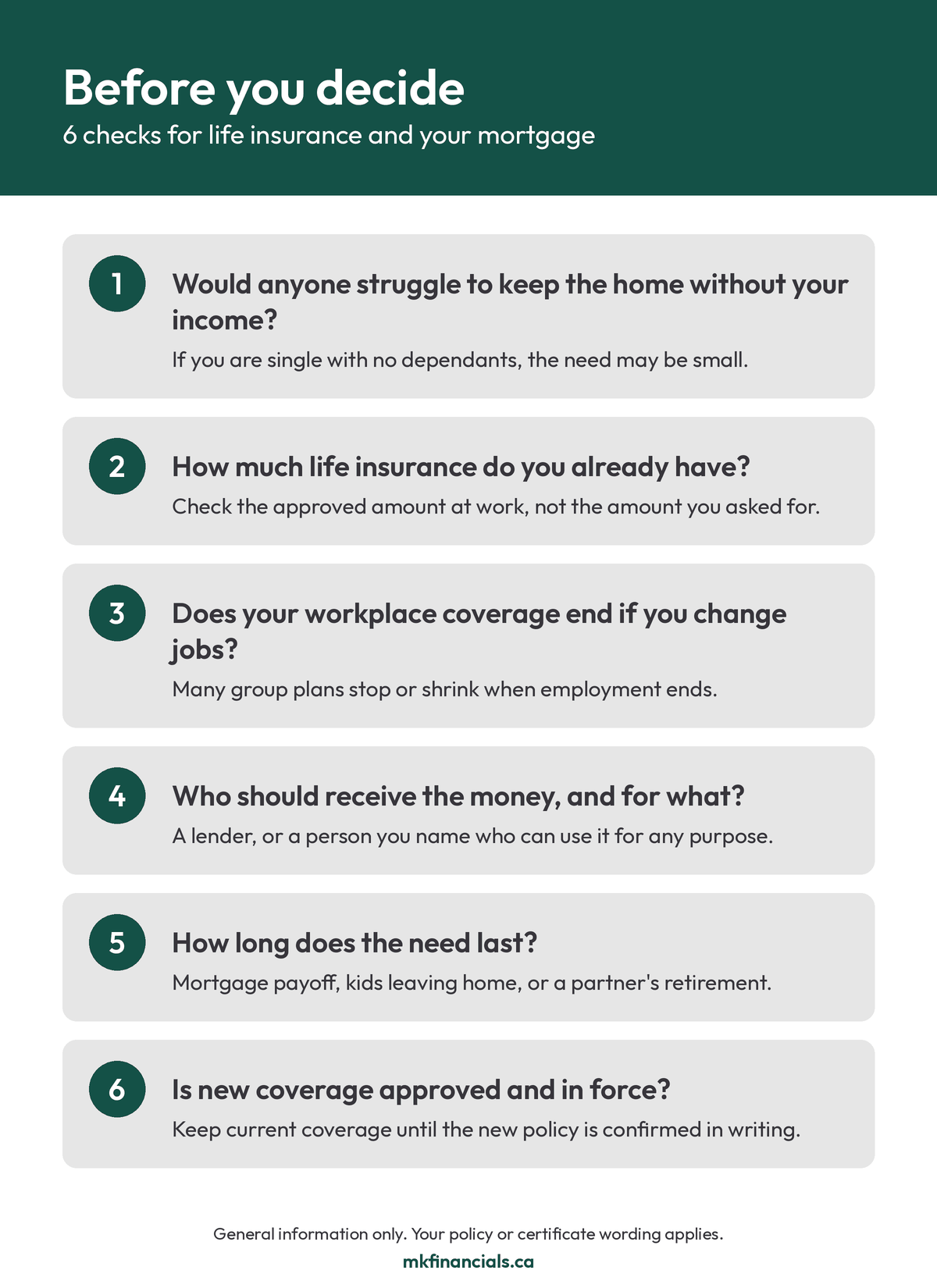
- Would anyone struggle to keep the home without my income? If not, the need may be small.
- How much coverage do I already have? Use the approved amount on your workplace certificate, not the amount you asked for.
- Would my workplace coverage end if I changed jobs? If yes, consider not counting all of it.
- Who should receive the money, and what should it pay for? The lender, or a person you name who can use it for anything.
- How long does the need last? Mortgage payoff, children leaving home, or a partner’s retirement.
- Is any new coverage approved and in force? Keep current coverage until the new policy is confirmed in writing.
Limits and trade-offs to keep in mind
- Personal policies need underwriting. FSRA explains that your application is reviewed and a decision is made on whether the policy can be issued on the terms you asked for. Coverage may be offered at a different price, with exclusions, or declined.
- Term coverage ends. If the term runs out before your need does, you may have to renew at a higher premium or apply again at an older age.
- Lender coverage follows the balance down. You generally pay the same premium for a shrinking benefit, and the money goes to the lender.
- Workplace coverage isn’t always yours to keep. It can end or shrink when you leave a job.
- More isn’t automatically better. Coverage you don’t need costs money that could go toward savings or the mortgage itself. A plan you can keep paying for is better than a bigger one you might drop.
Canadian details worth knowing
- Naming a beneficiary matters. FCAC says that if you don’t name one, your insurer will assume your estate is the beneficiary, and the money may then be exposed to estate costs and creditors.
- Quebec is different. FCAC notes that if you live in Quebec and name your spouse as beneficiary, they’re presumed irrevocable unless you specify otherwise.
- Children as beneficiaries. If a beneficiary is under the age of majority and there’s no trustee, FCAC says the province or territory will hold the money until they come of age. A lawyer can help you set up a trust.
- Couples have two options. FCAC explains that joint first-to-die coverage pays once, when the first partner dies, and is usually cheaper than two identical single policies, but it’s less flexible if you separate.
I’m licensed in Ontario, Alberta, British Columbia, Quebec, New Brunswick, Nova Scotia and Manitoba, and the questions above apply in each of those provinces. Your will, your home’s ownership and family law questions are for a lawyer in your province.
Frequently asked questions
1. Do you need life insurance for a mortgage in Canada?
No law or lender can require it. FCAC says optional mortgage insurance isn’t needed to be approved for a mortgage, and the lender must get your express consent. You may still want life insurance if someone relies on your income to keep the home.
2. Is CMHC insurance life insurance?
No. CMHC insurance is mortgage loan insurance. You need it if your down payment is less than 20%, and it protects your lender if you can’t make your payments. It doesn’t pay your family if you die.
3. How much life insurance do I need for my mortgage?
Start with the mortgage balance you would want covered, add other costs your family would face, such as lost income and childcare, then subtract savings and coverage you already have. The answer can be more or less than your mortgage.
4. Is mortgage life insurance from the bank a good idea?
It can suit someone who wants simple, mortgage-only protection. FCAC notes that the benefit decreases as you pay down your mortgage while premiums generally stay the same, and the lender receives the money. FCAC says term or permanent life insurance may provide better value.
5. Is my workplace life insurance enough to cover my mortgage?
It might be, but check the approved amount on your certificate and what happens if you leave your job. Workplace coverage often ends or changes when employment ends, so some families don’t count it in full.
6. Should my life insurance term match my mortgage?
Not always. Coverage should generally last as long as your longest need, which may be the amortization or the years until your children are independent. Your mortgage term is usually shorter than your amortization.
7. Can I cancel mortgage life insurance from my lender?
FCAC says you can cancel credit or loan insurance at any time, usually by contacting the insurance company. Make sure any replacement coverage is approved and in force before you cancel.
The bottom line
You don’t need life insurance to get a mortgage. You may need it to make sure your family can keep the home, or choose to sell it on their own timeline, if something happens to you. Work out the whole gap, not just the loan, and then choose the kind of coverage that pays the right people for the right length of time. If you’d like help with the numbers, I’m happy to walk through them with you.
This article is general information only and isn’t financial, insurance, tax or legal advice. Coverage, definitions, exclusions and costs vary by insurer, policy and personal circumstances, and the policy wording always applies. MK Financials works with Experior Financial Group as its managing general agency (MGA). Insurance policies are issued by the respective insurance companies.
Sources
- Financial Consumer Agency of Canada, Optional mortgage insurance products (checked October 26, 2026)
- Financial Consumer Agency of Canada, Credit or loan insurance (checked October 26, 2026)
- Financial Consumer Agency of Canada, Life insurance (checked October 26, 2026)
- Canada Mortgage and Housing Corporation, What is CMHC mortgage loan insurance? (checked October 26, 2026)
- Statistics Canada, Survey of Financial Security, 2023 (The Daily, released October 29, 2024)
- Financial Services Regulatory Authority of Ontario, Working with a life and health insurance agent or company (checked October 26, 2026)