Get a Quote
Life Insurance Planning in Canada

Life insurance should protect the life your family is building.

Life insurance can help your family manage the mortgage, replace income, support children and keep financial plans moving if you're no longer there. The harder part is deciding how much coverage you need, how long it should last and which type actually fits your situation.

Clear advice · Multiple insurer options · No-pressure conversations
Canadian family planning life insurance
What Is Life Insurance?

It creates money when the person who normally creates the income is gone.

Life insurance is a contract that can pay a death benefit to the named beneficiary when the insured person dies, subject to the terms of the policy.

In Canada, life insurance death benefits are generally paid to an individual beneficiary without income tax, although ownership and estate circumstances can affect the broader planning picture.

For most families, the purpose is practical: replace some of the financial value that person would have provided over the years ahead.

If your income helps pay the mortgage, groceries, childcare, savings or everyday expenses, your family may be relying on years of future income that haven't been earned yet.

A life insurance policy is a product. A life insurance plan is the reasoning behind why you own it.
What Can Life Insurance Help Protect?

Start with what your family would still have to pay for.

Coverage can give the people you love more financial room to make decisions after a loss.

01

Mortgage & debts

Coverage can help reduce or eliminate major liabilities so the surviving family isn't forced to make immediate decisions about the home simply because income disappeared.

02

Household income

Insurance can provide capital that helps replace some of the income used for groceries, utilities, transportation, housing and everyday family life.

03

Children

Childcare, activities, education and other future expenses continue even when one parent is no longer there.

04

Future financial plans

Coverage may help keep savings and investment plans intact instead of requiring the family to liquidate assets just to cover current expenses.

05

Estate & final needs

Some families also use insurance to address final expenses, estate obligations, tax liabilities or legacy objectives.

How Much Life Insurance Do I Need?

There isn't one number that works for every Canadian family.

A useful estimate starts with the obligations you want insurance to solve, then considers the resources already available to your family.

Mortgage + debts What liabilities would you want reduced or paid off?
Income replacement How much household income may need replacing, and for how many years?
Children + future expenses Childcare, education and other family goals can create additional needs.
Existing resources Existing insurance, savings and other available assets may reduce the remaining gap.
Free Calculator

Estimate your life insurance need.

Enter your mortgage, debts, dependants and income needs to get a starting estimate.

Calculate My Coverage
Family considering life insurance protection
Planning Around Real Life

The insurance question is really about what your family would have to figure out without you.

Life insurance works best when it reduces financial pressure during a time when your family already has enough to deal with.

Could the mortgage still be comfortably managed?
Would one income be enough for normal household expenses?
Would childcare or household responsibilities become more expensive?
Could education and savings plans continue?
Would the surviving spouse have time before making major financial decisions?
Life Insurance Options

Life insurance can solve different financial jobs.

The basic structure is usually term or permanent life insurance. From there, the way coverage is designed depends on who or what you're protecting, how long the need exists and how underwriting applies to you.

01

Term Life Insurance

Coverage for a defined period, commonly used for mortgages, children, income replacement and other financial needs expected to reduce over time.

Explore Term
02

Whole Life Insurance

Permanent life insurance with lifetime coverage and, depending on the product, guaranteed cash values and potentially non-guaranteed dividends.

Explore Whole Life
03

Universal Life Insurance

Permanent insurance that can provide more flexibility in how premiums, insurance costs and policy values are structured. It requires careful understanding of assumptions and ongoing funding.

Explore Universal Life
04

Mortgage Protection

Life insurance can be structured around one of the largest financial responsibilities many families carry: the mortgage. Personal coverage can offer different flexibility than lender-provided mortgage insurance.

Explore Mortgage Protection
05

Life Insurance for Children

Permanent coverage purchased while a child is young can provide lifelong insurance protection and, depending on the policy, future cash-value or insurability options.

Explore Children's Insurance
06

No Medical / Simplified Issue

An alternative underwriting route for people who may have health concerns, previous insurance difficulties or prefer a simplified application process. No medical exam does not necessarily mean no health questions.

Explore No Medical Insurance
07

Corporate-Owned Life Insurance

Business owners may consider life insurance for needs such as key-person risk, shareholder obligations, estate planning or other corporate protection strategies. Ownership and tax treatment require proper planning.

Explore Corporate Insurance
Not sure which one applies to you? You do not need to choose a product before speaking with us. Start with the financial problem you're trying to solve.
Who Should Consider Life Insurance?

If someone or something depends on your financial contribution, there may be a need.

Life insurance isn't only for one type of family. The need usually begins when your death would create a financial consequence for someone else.

01
Parents with dependant children Income, childcare and future education expenses may continue for many years.
02
Couples with a mortgage One person's income may be essential to keeping the home affordable.
03
Single-income households When one person provides most household income, the financial dependency can be especially significant.
04
Business owners Business debts, ownership obligations and key-person risk may create additional needs.
05
People supporting parents or relatives Financial dependency is not limited to spouses and children.
06
People planning an estate or legacy Some permanent insurance needs relate to estate costs, taxes or money intended for future generations.
How Long Should Life Insurance Last?

Match the term to the responsibility.

A shorter policy may look cheaper today. The better question is whether the financial need will still exist when that term ends.

Mortgage A mortgage with 25–30 years remaining may create a longer protection timeline than a short-term policy.
Children Parents often consider how long their youngest dependant may require financial support.
Income Ask how many years of income the household would realistically need to replace.
Other obligations Business debts, education plans and other commitments can create separate protection timelines.
Why Compare Life Insurance Companies?

The same person can receive different pricing and product options from different insurers.

Canadian insurers can differ in pricing, underwriting appetite, conversion privileges, policy features, product design and how they assess certain medical or lifestyle factors.

That is why the planning process should not begin by assuming one company is automatically right for everyone.
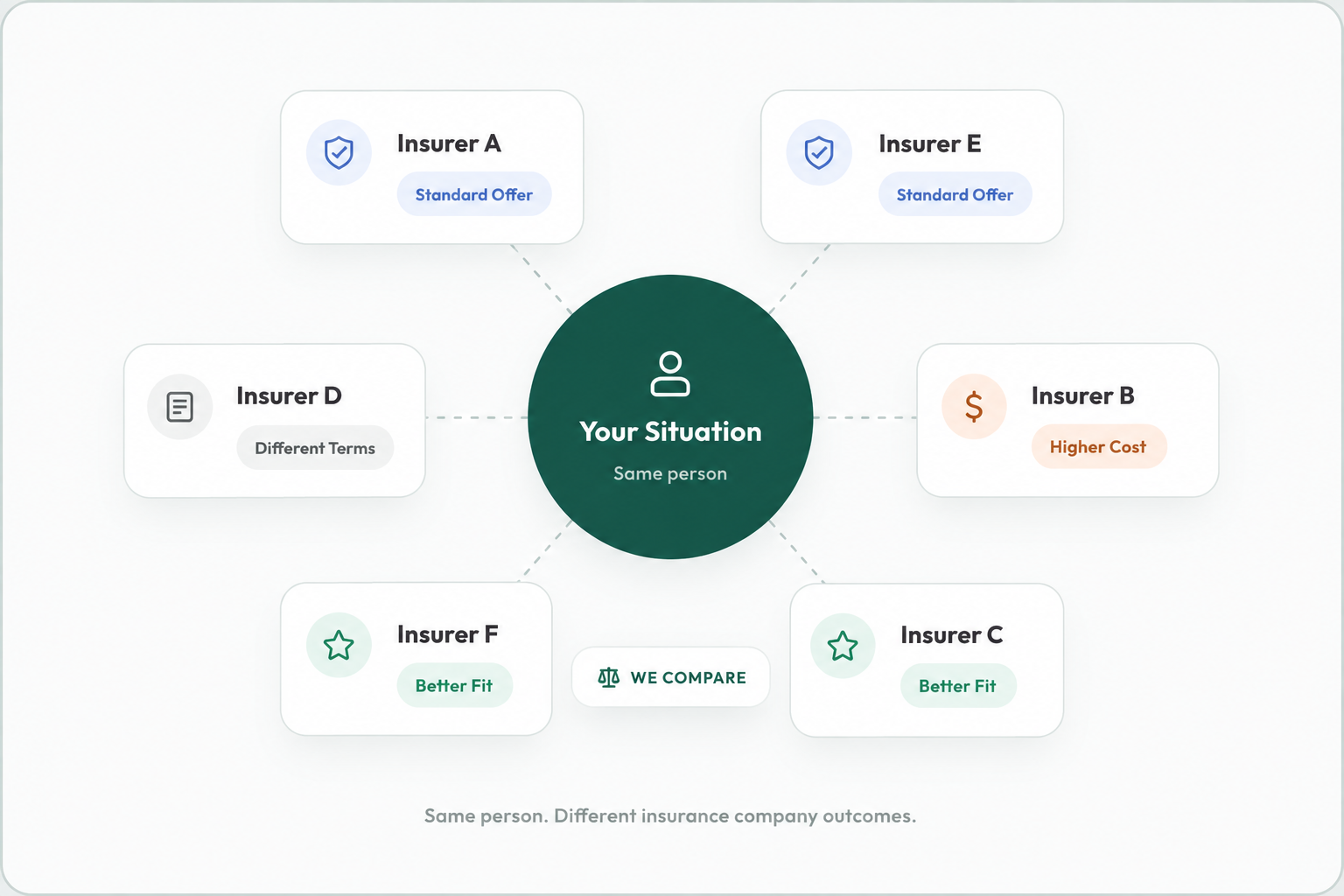

Market knowledge matters because the recommendation is only as useful as the alternatives considered.
Comparison of Canadian life insurance companies
MK Financials life insurance advisor
How We Approach Life Insurance

The policy should make sense because the reasoning makes sense.

We start with your family, responsibilities and budget. Then we work into the coverage amount, timeline and policy options instead of starting with a product we already want to recommend.

01
Understand the real need. What financial problem are we actually solving?
02
Compare meaningful alternatives. Coverage amount, term, insurer and product structure all matter.
03
Respect the budget. Coverage only helps if it can realistically remain in force.
04
Explain the trade-offs. Every option gives you something and gives something up.
05
Make sure the decision is understood. You should know why you own the policy before you buy it.
Life Insurance FAQ

Common questions Canadians ask.

Straight answers to questions that often come before choosing a policy.

Life insurance is a contract under which an insurer can pay a death benefit to the named beneficiary when the insured person dies, subject to the policy terms. Families commonly use it to help replace income, pay debts and preserve financial plans.
The amount depends on your family's financial obligations. A needs analysis may consider mortgage and other debts, income replacement, children, future expenses, existing insurance and available assets.
Pricing depends on factors such as age, health, smoking status, coverage amount, insurance type, term length and underwriting. Different insurers may also price the same applicant differently.
The two broad categories are term life insurance and permanent life insurance. Permanent life insurance includes products such as whole life and universal life. Other life insurance solutions may be designed around mortgages, children, business ownership or simplified underwriting.
Neither is universally better. Term insurance is commonly used for temporary needs such as mortgages and income replacement. Permanent insurance may be appropriate where a lifelong insurance need exists.
The term should generally reflect how long the financial responsibility is expected to exist. Mortgage years remaining, children's ages, income replacement needs and other obligations can all influence the timeline.
Some simplified-issue or no-medical-exam products may be available. However, no medical exam does not necessarily mean no health questions, and traditional underwriting may provide better pricing or coverage when an applicant qualifies.
Yes. Personal life insurance and lender-provided mortgage insurance can differ in ownership, beneficiary structure, coverage design and how the benefit relates to the mortgage. Compare the actual contracts before choosing.
Review coverage after major changes such as marriage, buying a home, having children, changing income, starting a business, taking on major debt or approaching the end of an existing term.

You don't need to know which policy to ask for.

Start with what's happening in your life. We'll help you work backward from the financial need into the coverage.

Get a Quote

This page is provided for general educational purposes and does not constitute individualized insurance, financial, tax or legal advice. Coverage availability, premiums, underwriting requirements, policy features, guarantees, exclusions, conversion privileges and other terms vary by insurer, product and individual circumstances. Recommendations should be based on an appropriate review of your needs and financial situation.
