Last reviewed by Manish Kumar: October 26, 2026. Statistics were checked against the primary sources listed at the end of this article.
“If I already have life insurance, do I really need critical illness insurance too?” It’s one of the most common questions I hear from families and business owners here in London, Ontario.
It’s a fair question. Both pay out a lump sum, both involve an application and some health questions, and both are meant to protect the people who depend on you. But they answer two very different questions. Life insurance asks, “What happens to my family if I die?” Critical illness insurance asks, “What happens to my family if I get seriously sick and live?”
In my conversations, most people have thought carefully about what happens if they die, but far fewer have thought about what happens if they get sick and survive. That second scenario is often the bigger financial surprise. Let’s walk through how each one works, where they overlap, and how to decide what makes sense for you.
The short answer
- Life insurance pays a death benefit to your beneficiaries if you die while the policy is in force.
- Critical illness insurance pays a lump sum to you if you’re diagnosed with a covered condition, such as many cancers, a heart attack or a stroke, that meets the policy’s definition, and you live through the survival period.
- One protects the people you leave behind. The other protects you and your household while you recover.
- Neither replaces the other. Many families end up with some of each, sized to their budget.
How life insurance works
Life insurance is the one most people know. You choose an amount of coverage, pay premiums, and if you pass away while the policy is in force, the insurer pays the death benefit to the people you’ve named as beneficiaries.
That money is there to replace what your family loses when you’re gone: your income, your help paying the mortgage, childcare, your children’s education, and final expenses. The Financial Consumer Agency of Canada describes the death benefit as a one-time, tax-free payment to your beneficiaries (FCAC). For business owners, it can also fund a buy-sell agreement or keep the business steady during a transition.
Most families start with term life insurance, which covers a set period, like 10, 20 or 30 years, while the kids are young and the mortgage is big. Permanent policies (whole life and universal life) last for your lifetime and are usually used for estate or longer-term planning.
Not sure how much you’d need? Our how much life insurance do I need calculator gives you a starting number in a few minutes.
How critical illness insurance works
Critical illness insurance is about surviving. Thanks to modern medicine, many Canadians now survive a cancer diagnosis, heart attack or stroke. That’s wonderful news, but recovery can take months, and the bills don’t stop.
A few numbers put this in perspective:
- About 2 in 5 Canadians are expected to be diagnosed with cancer in their lifetime (Canadian Cancer Society, 2026).
- Five-year net survival for all cancers combined is now about 64%, up from 55% in the early 1990s (Canadian Cancer Statistics 2025).
- More than 6 million people in Canada are living with heart disease or stroke, and the death rate from these conditions has fallen by more than 80% over the past seven decades (Heart & Stroke, 2026).
In other words, more people are living through serious illness than ever before. Surviving is the goal, and it’s also exactly the situation life insurance isn’t built for.
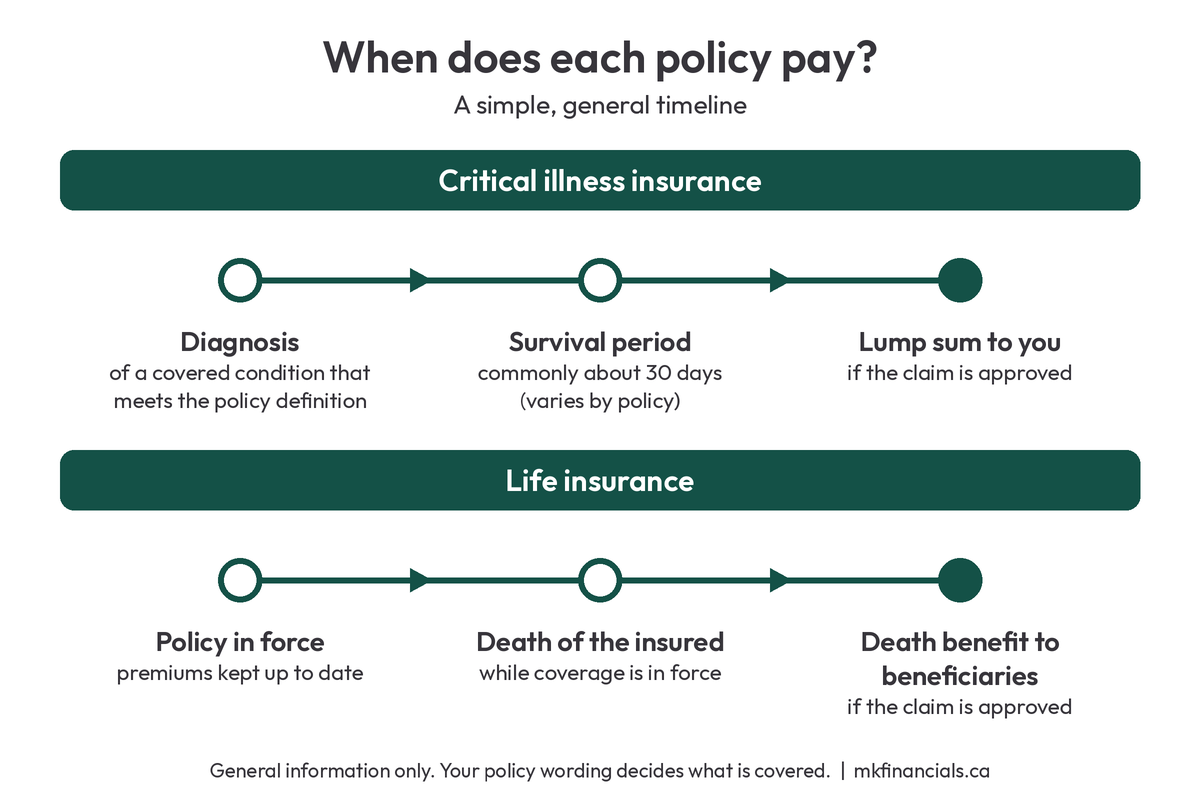
Here’s how it usually works:
- You’re diagnosed with a condition listed in your policy.
- Your doctor or specialist provides the medical evidence the insurer needs.
- The insurer checks that your diagnosis meets the policy’s exact definition. A condition’s name alone isn’t enough.
- You live through the survival period. This is commonly about 30 days after diagnosis, but check your own policy.
- If the claim is approved, the insurer pays you one lump sum.
The big advantage is flexibility. The money is yours to use however you need: covering your income while you’re off work, paying for treatment or medication not covered by OHIP or your workplace plan, keeping up with the mortgage, paying for travel to appointments, or letting your spouse take time off to help.
What’s usually covered? Most Canadian critical illness policies are built around the “big three”: cancer (generally life-threatening cancers, with some early-stage cancers covered only partly or not at all), heart attack and stroke. Many policies add a longer list, such as coronary bypass surgery, kidney failure, major organ transplant, multiple sclerosis and others, depending on the plan.
One important caution: every policy has its own list of covered conditions, definitions and exclusions. Two policies can both say “cancer” and still define it differently. The Canadian Life and Health Insurance Association publishes benchmark definitions that many insurers refer to, but using them is voluntary (CLHIA, last reviewed 2024). That’s why it’s worth reading the wording, or having someone walk you through it. You can learn more on our critical illness insurance page.
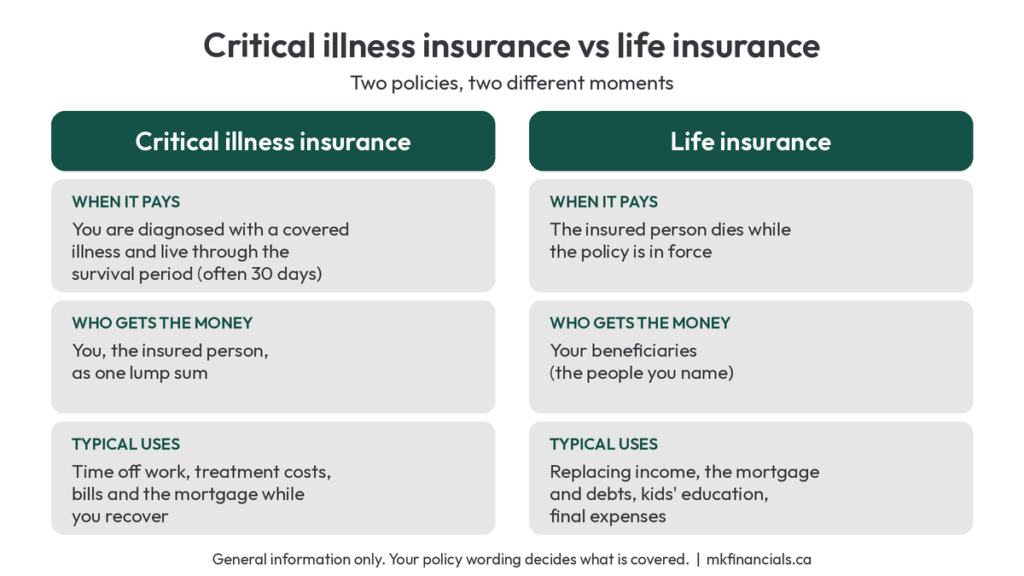
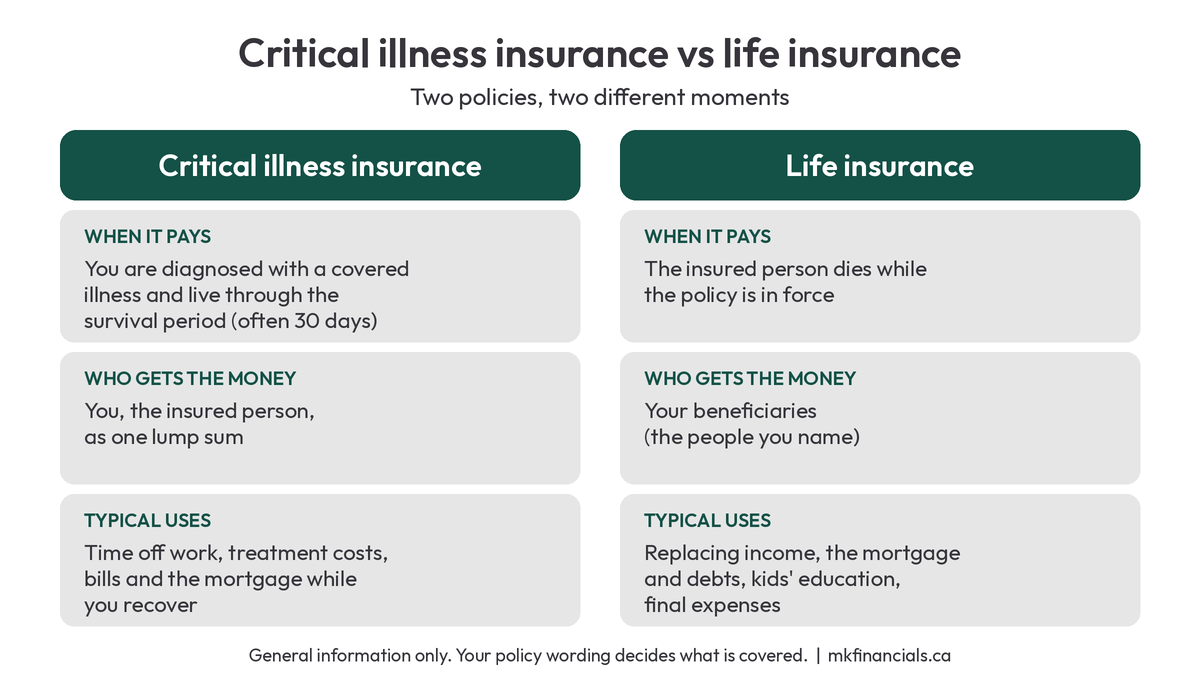
Critical illness insurance vs life insurance at a glance
| Critical illness insurance | Life insurance | |
|---|---|---|
| Pays when | You’re diagnosed with a covered condition and survive the survival period | The insured person dies while the policy is in force |
| Paid to | Usually you, the insured person | Your named beneficiaries |
| How it’s paid | One lump sum | One lump sum (death benefit) |
| Main job | Keeping your household afloat while you recover | Replacing your income and paying debts after you’re gone |
| Common uses | Time off work, treatment costs, bills, mortgage payments | Income replacement, mortgage payoff, education, final expenses |
These are general patterns. Your actual policy wording always decides what’s covered.
What about the coverage you have through work?
Many Canadians have some life insurance, and sometimes critical illness coverage, through an employer plan. It’s a great benefit, but it has limits. Ontario’s regulator, FSRA, notes that group life coverage is usually a basic amount, often a multiple of your salary such as two or three times, and that it usually ends when you leave your job. Some plans let you convert to an individual policy (FSRA).
A pattern I see often is that people assume their workplace plan has them covered until they actually read the benefits booklet. Before you rely on it, check three things: how much life coverage you have, whether critical illness is included at all, and what happens to both if you change jobs, get laid off or start your own business.
Which one do you need?
I find it helps to stop thinking about products for a minute and picture two scenarios instead.
Scenario one: you pass away. Who would struggle financially? How much would your partner need to keep the house, raise the kids and get back on their feet? That gap is the job for life insurance.
Scenario two: you get seriously sick, but you survive. Could your household cover six months or a year of reduced income, extra costs and maybe a partner taking time off? If not, that gap is the job for critical illness insurance.
A few general patterns I see:
- Young families with a mortgage usually make life insurance the priority, then add critical illness coverage as the budget allows.
- Single people with no dependants may need less life insurance, but a serious illness could still hit their own finances hard, so critical illness coverage is often worth a look.
- Self-employed people and business owners often have no paid sick leave. A lump sum during recovery can keep both the household and the business going.
There’s no single right answer. The right mix depends on your income, your debts, the people relying on you, your savings and what you can comfortably afford each month.
Example only: one Ontario family, two scenarios
Example only. This is a made-up household to show how each benefit might be used. It isn’t a quote, a recommendation or a real client.
Priya is 35, lives in Ontario, and has a partner, two young children and a $300,000 mortgage. Both incomes go toward the mortgage and family expenses.
If Priya passed away, a life insurance payout to her beneficiaries could be used to:
- pay off or pay down the $300,000 mortgage so her partner can stay in the home;
- replace her share of the household income for a number of years;
- set money aside for the children’s education; and
- cover final expenses and any other debts.
If Priya had a heart attack and recovered, there would be no life insurance claim, because she’s alive. A critical illness lump sum paid to her, if the condition met the policy definition, could be used to:
- cover her lost income during several months off work;
- keep the mortgage payments up to date;
- let her partner take time off to help at home and with the kids; and
- pay for rehab, medication or travel to appointments not covered elsewhere.
Same family, same mortgage, but two completely different needs. That’s the whole point.
5 questions to ask before choosing
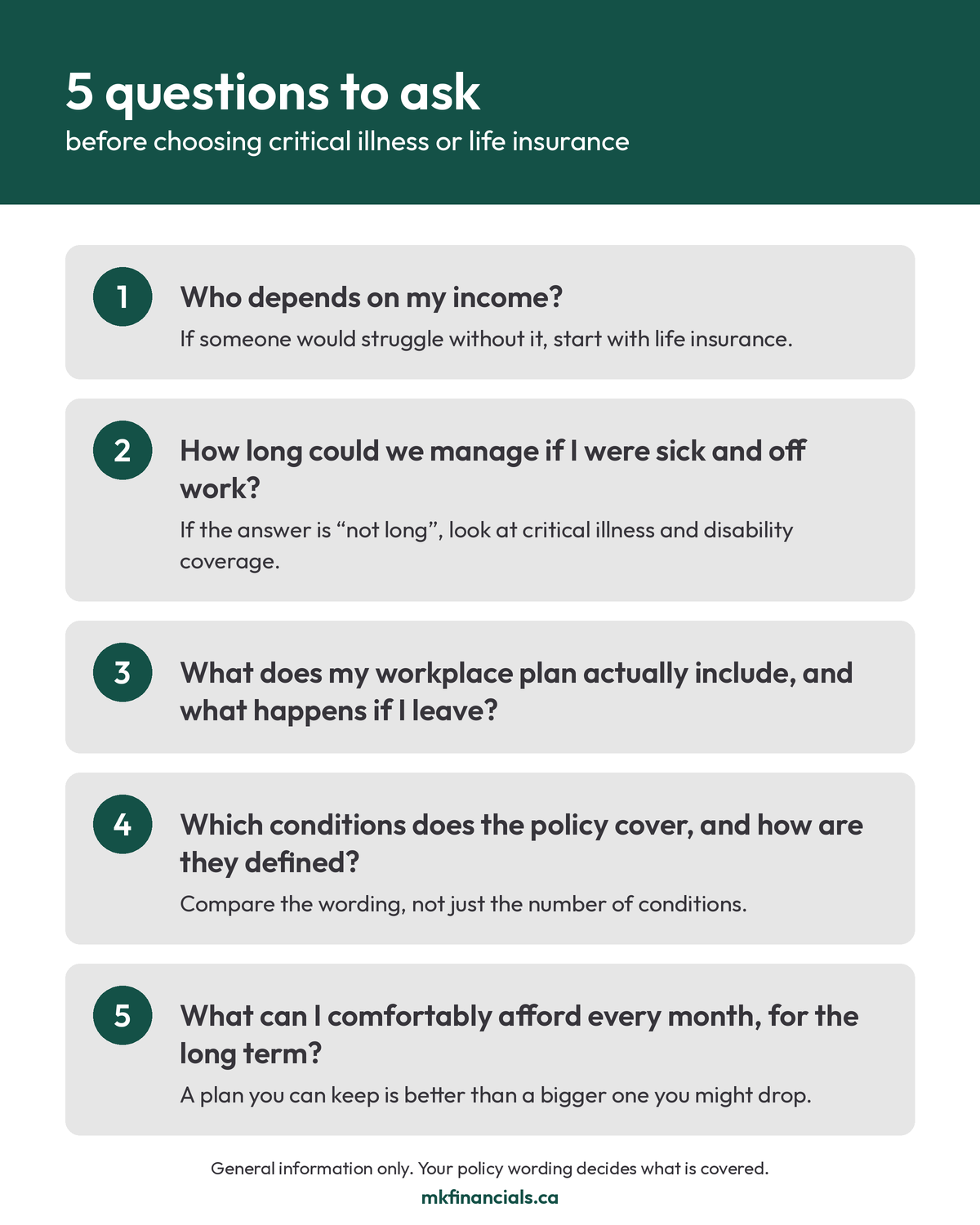
- Who depends on my income? If someone would struggle without it, start with life insurance.
- How long could we manage if I were sick and off work? If the answer is “not long”, look at critical illness and disability coverage.
- What does my workplace plan actually include, and what happens if I leave?
- Which conditions does the policy cover, and how are they defined? Compare the wording, not just the number of conditions.
- What can I comfortably afford every month, for the long term? A plan you can keep is better than a bigger one you might drop.
Want to see what each would cost for you? I’ll compare options side by side and explain the differences in plain language, with no pressure to buy.
Trade-offs to keep in mind
Neither policy is perfect, and it’s worth knowing the limits before you buy.
- Critical illness insurance only pays for conditions listed in the policy that meet its definitions. It may pay a partial benefit or nothing for some early-stage conditions, and you need to live through the survival period. For the same coverage amount, it often costs more than term life.
- Life insurance generally pays nothing while you’re alive, even if you’re seriously ill. A term policy ends at the end of its term, and if it expires before you die, there’s no payout.
- Both require ongoing premiums, are underwritten separately, and depend on the exact policy wording. Neither replaces emergency savings or disability coverage for a long-term loss of income.
Can you have both?
Yes, and many people do. Because the two policies cover different events, they don’t compete with each other. If you’re diagnosed with a covered illness and recover, your critical illness policy may pay, and your life insurance stays in place. If you later pass away while your life policy is still in force, your beneficiaries can make a separate claim.
Keep in mind that each policy is underwritten and approved separately. Some people add critical illness as a rider on a life policy, while others buy a standalone policy, and each approach has trade-offs. Whatever you do, don’t cancel existing coverage until a new policy is approved and in force.
What about disability insurance?
Critical illness insurance pays for a specific diagnosis. Disability insurance pays a monthly income if illness or injury stops you from working, whatever the cause. A bad back or a mental health condition might keep you off work without being on a critical illness list. If your income is what keeps your household running, it’s worth looking at disability coverage too.
A quick note on taxes
In many personal situations, life insurance death benefits and critical illness benefits are received tax-free in Canada. But how a policy is owned and paid for (personally, through a corporation, or through an employer) can change the picture. If you own a business or are thinking about holding a policy in your corporation, please check with your accountant before you decide.
Frequently asked questions
1. Is critical illness insurance the same as life insurance?
No. Life insurance pays your beneficiaries when you die. Critical illness insurance pays you a lump sum if you’re diagnosed with a covered condition and survive the survival period. They protect against different events.
2. If I have life insurance, do I still need critical illness insurance?
It depends on whether your household could handle a long recovery. Life insurance generally won’t pay while you’re alive, so if a serious illness would put real strain on your income or savings, critical illness coverage can fill that gap.
3. What illnesses does critical illness insurance cover?
Most Canadian policies cover the big three: cancer, heart attack and stroke. Many also cover a longer list of conditions. Each one has a specific definition in the policy, so always check the wording rather than relying on the name of the illness.
4. What is the survival period in critical illness insurance?
It’s the number of days you need to live after diagnosis before the benefit can be paid. It’s commonly around 30 days, but it varies by policy and condition.
5. Which is cheaper, critical illness or life insurance?
For the same coverage amount, critical illness insurance often costs more than term life insurance, because the chance of a serious illness during your working years is generally higher than the chance of dying. Your actual premium depends on your age, health, coverage amount and the policy you choose.
6. Can I add critical illness coverage to my life insurance policy?
Often, yes. Many insurers offer critical illness coverage as a rider on a life policy. A standalone policy can give you more flexibility, so it’s worth comparing both before you decide.
The bottom line
Life insurance protects your family if you’re gone. Critical illness insurance protects your family while you’re still here and fighting to get better. They’re not rivals. They’re two tools for two different moments.
If you’re still weighing whether critical illness coverage is right for you, read Is critical illness insurance worth it in Canada? And if you’d like to talk it through, I’m happy to help you figure out what fits your family and your budget.
This article is general information only and isn’t financial, insurance, tax or legal advice. Coverage, definitions, exclusions and costs vary by insurer, policy and personal circumstances, and the policy wording always applies. MK Financials works with Experior Financial Group as its managing general agency (MGA). Insurance policies are issued by the respective insurance companies.
Sources
- Canadian Cancer Society, Cancer statistics (2026)
- Canadian Cancer Statistics Advisory Committee, Canadian Cancer Statistics 2025 (PDF)
- Heart & Stroke, New data provides big picture of heart and brain risk factors (February 3, 2026)
- Financial Services Regulatory Authority of Ontario, Life and health insurance policy types
- Financial Consumer Agency of Canada, Life insurance
- Canadian Life and Health Insurance Association, Critical Illness Benchmark Definitions (reviewed 2024)